Polygon: What is polygon(Find the answers examples)-Google
A plain figure with at least three straight sides and angles.
Complete the table below: you must cut and paste the correct
image and definition for each shape. Use the internet to help if
you get stuck.
Triangles
3 sides
The interior angles add to 180 o
|
Quadrilaterals
4 sides
The interior angles add to 360 o
|
Other sided Polygons
|
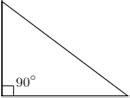
Right angled triangle
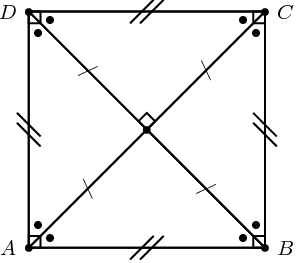
It could be classified as a special kind of rhombus with all four interior angles equal to 90 o or it could also be classified OR it could be classified as a special kind of rectangle with all four sides equal in length.
Both pairs of opposite sides are parallel.
All sides are equal in length.
All interior angles equal 90 o
Lines of symmetry: 4
Order of rotational symmetry: 4 The diagonals bisect each other at 90 o and are equal in length The diagonals bisect both pairs of opposite angles both pairs of interior opposite angles |
Square
It is a special kind of parallelogram with all four sides of equal length.
Both pairs of opposite sides are parallel.
Both pairs of opposite sides are equal in length.
Both pairs of opposite angles are equal.
All sides are equal in length.
Lines of symmetry: 2
Order of rotational symmetry: 2
The diagonals bisect each other at 90 o
The diagonals bisect both pairs of opposite angles.
|
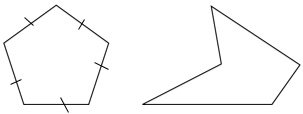
Pentagon
5 sided polygon
Regular polygon
5 equal sides
5 equal interior angles where each angles is 108 o
Lines of symmetry: 5
Order of rotational symmetry: 5
 |
Isosceles triangle

It is a quadrilateral with two pairs of adjacent sides equal and one interior angle that is more than 180 o
One interior reflex angle
Two pairs adjacent sides of equal length
Lines of symmetry: 1
Order of rotational symmetry: 0
|
Rectangle
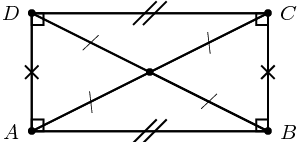
It could be classified as a special kind of parallelogram that has all four angles equal to 90 o.
Both pairs of opposite sides are parallel.
Both pairs of opposite sides are of equal length.
Both pairs of opposite angles are equal.
All interior angles are equal to 90 o
Lines of symmetry: 2
Order of rotational symmetry: 2
Diagonals are equal in length.
Both diagonals bisect each other.
|
Hexagon
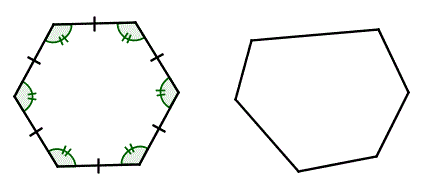
6 sided polygon
Regular polygon
6 equal sides
6 equal interior angles where each angles is 120 o
Lines of symmetry: 6
Order of rotational symmetry: 6
|
Equilateral triangle
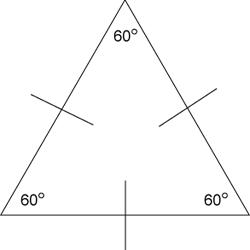
A triangle that has three equal sides
The angles all equal to 60 o
There are 3 lines of symmetry
The order of rotational symmetry is 3.
|
Parallelogram
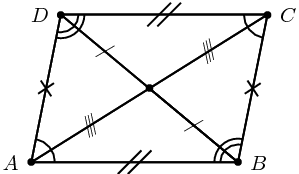
It is a quadrilateral with both pairs of opposite sides parallel.
Both pairs of opposite sides are parallel.
Both pairs of opposite sides are equal in length.
Both pairs of opposite angles are equal.
Lines of symmetry: 0
Order of rotational symmetry: 2
Both diagonals bisect each other.
|
Heptagon

Regular polygon
7 equal sides
7 equal interior angles where each angles is 128.6 o
Lines of symmetry: 7
Order of rotational symmetry: 7
|
Isosceles Trapezium
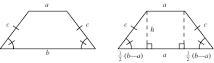
It is a special kind of trapezium with one opposite pair of sides that are equal in length
Only one pair of parallel lines (bases)
The non-parallel, opposite sides are the same length
The angles on either side of the bases are the same size
The diagonals the same length
Lines of symmetry: 1
Order of rotational symmetry: 0
|
Rhombus
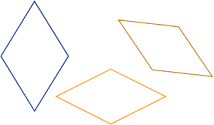
A rhombus is a parallelogram that has all equal sides
The opposite sides are parallel and the opposite angles are equal.
It is known as a parallel shape or in others words, an equilateral quadrilateral.
|
Octagon
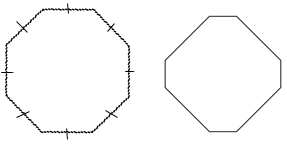
8 sided polygon
Regular polygon
8 equal sides
8 equal interior angles where each angles is 128.6 o
Lines of symmetry: 8
Order of rotational symmetry: 8
|
Trapezium
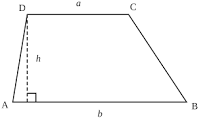
A trapezium is a quadrilateral with one pair of sides that are parallel.
It is a shape with unequal sides as for the base and top.
|
Arrowhead
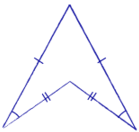
A quadrilateral where one interior angle is more than 180o
The two sides are equal leading to a point at the centre and top of the shape.
There are also two lines that go inside the shape which are also equal, making it looking like an arrow.
|
Decagon
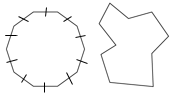
10 sided polygon
Regular polygon
10 equal sides
10 equal interior angles where each angles is 144o
Lines of symmetry: 10
Order of rotational symmetry: 10
|
Kite

A kite is a quadrilateral
It is a shape where a group of two sides that are adjacent to each other have the same equal.
|
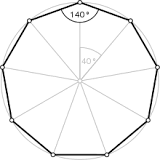
Nonagon
9 sided polygon
Regular polygon
9 equal sides
9 equal interior angles where each angles is 140 o
Lines of symmetry: 9
Order of rotational symmetry: 9
 |